Do you know any LeCompte's who wear eyeglasses? If they are
descendants of Antoine's son Moses, it may just be the remnants of an old
Indian curse.
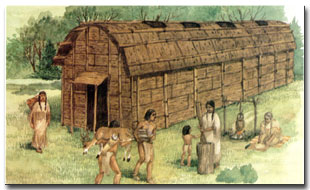
The generally peaceful Choptank Indians lived in longhouses, not teepees, along the coastal waters of the Chesapeake Bay.
We do know that Antoine and a Mr. Horn explored the coastal land
of the Great Choptank River in the late 1650's and settled around a bay, later
known as LeCompte Bay, on either side of a creek, later known as LeCompte
Creek. We also know that Choptank Indians, a sub-tribe of the Algonquin, lived
by fishing these shores, and though capable of war, were generally a gentle
people living in longhouses along the coastline.
As the land was sparsely inhabited by Europeans, the early
settlers built homes that doubled as fortifications against any potential
threat by the slightly more populous Indians. Encounters between the two
cultures were occasionally bloody, but Antoine must have had adequate servants
and armory to fend off any attacks. His great-grandchildren told stories of how
he dispersed the Indians "by firing guns of most every size."
Although there is no evidence of a specific encounter, and there
is no mention of a curse in the family manuscript of 1819, some family stories
relate how in an act of self-protection, or perhaps overzealousness, Antoine
killed members of the Choptank, perhaps the tribe of Chief Hatchwop, and
consequently the Indians cursed his family with blindness. There is no doubt
that Antoine's 2nd son Moses went blind in his early 20's, from what we today
assume was Retinitus Pigmentosa, and that the "curse of blindness" afflicted 9
of Moses's children and more than 40 of his descendants.
Of course, before deciding whether there was ever really a curse,
bear in mind that the 1800's produced a number of so-called 'Indian Curse'
stories. Perhaps the most famous of them was the curse of Tecumseh that
supposedly killed sitting Presidents elected every 20 years from 1860 to 1960. Just as this curse is unlikely to have
been uttered, it is equally unlikely that a LeCompte curse was invoked.
However, I must note that as a direct male descendant of the first
blind Moses LeCompte, I can attest that I, like my father's before me, although
not blind, am quite helpless without a thick pair of spectacles mounted on my
nose.
Sources:
Old Harford Town Maritime Center. "Choptank & Tuckahoe
River Guide." [Online] 2003 previously at http://www.riverheritage.org/Riverguide/index.html and
http://www.riverheritage.org/Riverguide/Sites/html/indian_purchase.html
updated url: http://www.choptankriverheritage.org/RiverGuide/
Jones, Elias. "Revised History of Dorchester County
Maryland." (Baltimore: 1925). [Not Available Online]
Cochrane, Laura C., et. al. "The History of Caroline County,
Maryland, From Its Beginning." (Denton, MD: 1920). pp. 35-40. Transcribed by
Adina Watkins Dyer for Caroline County MDGenWeb 2000. [Online] 2003 at http://www.rootsweb.com/~mdcaroli/ESIndians.html
Rountree, Helen C. "Native Americans." Transcribed for Maryland Humanities Council (2001). [Online] 2003 previously at http://www.mdhc.org/bibliotest/essays.php?essay=21
Living in Longhouses. [Online] 2003 previously at
http://www.scott.k12.va.us/martha2/longhouses.htm
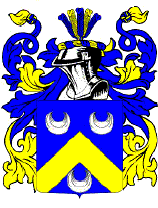
Coat of Arms
This coat of arms from
Normandy is known to belong to the Gravelle family, althought it is frequently
cited, probably incorrectly, as belonging to the LeCompte family.
There are numerous coat-of-arms that have been described for the
LeCompte family, probably because of the multitude of spellings and families
that appear in different places and times from Belgium to France to England.
There is also uncertainty as to whether Anthony, the immigrant, had a
coat-of-arms before he left France, and whether he had one recorded in the
Herald's College for his service to the King of England in the 1640's.
There are certainly numerous Internet vendors who are ready and
willing to find and print your coat of arms on a mug, shirt, or scroll.
Unfortunately, they all differ slightly on the specifics of what constitutes
the LeCompte shield. More alarmingly, the shield they often suggest resembles a
bit too closely the shields of many other names.
A rendering of the shield that hung in the home ofBenjamin Berry LeCompte Sr in Richmond, VA.
One possible, unverified coat of arms that is frequently
associated with the LeCompte name is described as "a blue shield with a gold
chevron between three silver crescents." The Crest is often identified as a
lion, and the motto is generally unknown. Other sites suggest that "on a red
background there is a gold lion with two silver stars." Still others report "a
shield divided bendy red and gold with three escallops on a blue chief." None
of these sites document the source for identifying the shield.
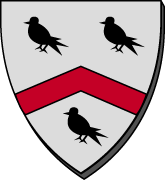
The coat of arms shield that hung in the home of Benjamin Berry
LeCompte of Richmond, VA simply displayed a red chevron and three black ravens
with the motto, "The Lord Feeds the Raven." The motto is clearly a Bible
reference to the Grace of God:
Luke 12:24 "Consider the ravens: for they neither sow nor
reap; which neither have storehouse nor barn; and God feedeth
them."
Ravens would have been a common sight flying over battlefields in
medieval times, eager to feast on the dead. Perhaps the idea was that the
knight carrying the raven shield would be the one feasting at the conclusion of
the battle.
This Le Compte shield has
Belgian roots according to research by Robert J. Dubois.
The web site of Robert J. Du Bois, a Le Compte of Belgian
ancestry, tells us a bit more, and also displays a "raven-like" shield that was
purportedly:
"drawn by an heraldic artist from information officially
recorded in ancient heraldic archives. Documentation for the Le Compte Coat of
Arms design can be found in Rietstap Armorial General. Heraldic artists of old
developed their own unique language to describe an individual Coat of Arms. In
their language, the Arms (shield) is as follows:
"D'arg. au chev. de gu., acc. de trols
corbeaux de sa.'
"When translated the Arms description is: "Silver: a red
chevron between three black crows." Family mottos are believed to have
originated as battle cries in medieval times. A Motto was not recorded with the
Le Compte Coat of Arms."
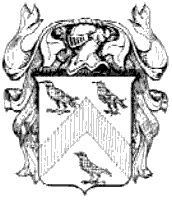
Elias Jones, in his book "Revised History of Dorchester County"
(1925, p397), includes a drawing of yet another coat of arms for the Le Comte
surname, which he presumably acquired from Samuel E. LeCompte of Cambridge, MD.
Unfortunately, he gives no source or traditional description for the
drawing.
Unfortunately, a search in May 2004 by William Hunt, Windsor
Herald for the College of Arms in London, concluded that no knighthood of
Antoine LeCompte (or its various spellings) is to be found in England. However,
there remains the possibility that Antoine carried his family Arms from the
European continent rather than for service to the English King.
Editors Note: If anyone has more concrete information on the
proper shield for the family of Anthony LeCompte, please let us know!
HISTORY OF COAT OF ARMS Insignia were not hereditary at first and knights were free to
choose their own symbols, as were wealthy individuals, families, towns,
lordships, abbeys and other groups who had gained the favor of the reigning
monarch. As confusion and duplication grew so did the complexity of these
symbols. What had started out as a simple form of identification and pride had
risen to a complex system of inherited social status. The problem became so
widespread that in 1484 the Herald's College was established in Britain to
oversee all claims of subjects to armorial rights. No arms were considered
legal unless recorded in the College.
Jones, Elias. "Revised History of Dorchester County
Maryland." (Baltimore: 1925). [Not Available Online]
HistoricalNames.com. [Online] 2003 previously at http://www.historicalnames.com/
LeCompte Translated and Pronounced
The CountOr The Accountant?
When you know a little French and you learn
that LeCompte translates "The Count," you can't help wonder whether your
ancestors were royalty. Then you realize that the French verb 'compter' means
'to count' and not 'the count.'
According to most sources, the surname Le
Compte appears to be occupational in origin, and is believed to be associated
with the French, meaning, "one who kept the accounts." The most prominent
variations of Le Compte are Lecompte, Lecompes and Les Comptes. One ancient
origin of the name may be Languedoc in Southern France.
But how do your pronounce it? Perhaps the best way is how our own grandparents taught us. Two predominant versions are "lah kount" or "luh kawmpt". Antoine would likely have had a much richer, french accent more akin to "luh kohmt" with a long "o" sound. Just like our gene pool, pronunciation changes with time and geography. There's no right or wrong. There's simply what we hear and say.
The Author
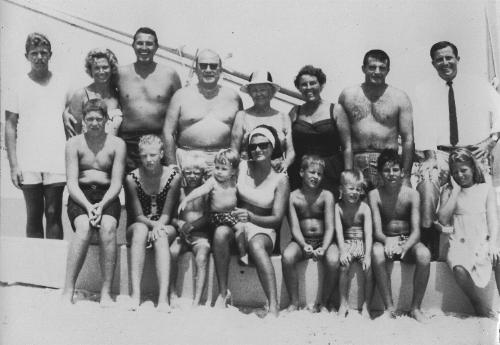
In case you are wondering who authored and produced this web site, it is the littlest boy at the beach in the following picture.
Family photo of Ben & Isabel (Collie) LeCompte taken summer 1966 on the beach in Virginia Beach, VA at 57th Street. Standing (l to r): Benjamin Berry LeCompte III, Carmen (Pettus) LeCompte, Benjamin Berry LeCompte Jr., Benjamin Berry LeCompte Sr., Isabel (Collie) LeCompte, Isabel "Sys" (LeCompte) Schulte, Walter Lane Schulte, Edwin Lee LeCompte. Seated (l to r): Hunter Pettus LeCompte, Carmen
Rebecca "Becky" LeCompte, William Harvey "Bill" LeCompte, Kirkwood Adams LeCompte, Jane (Saunders) LeCompte, Lee Mason Schulte, Walter Kent Schulte, Michael Lane Schulte, Jane Burrows "Jebbie" LeCompte
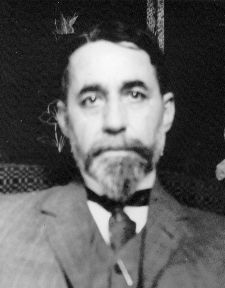
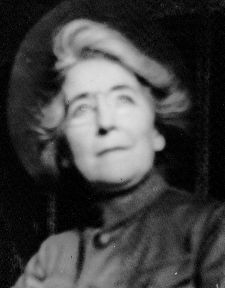
My grandfather's father: Frank Layton Foxwell LeCompteMy grandfather's mother: Mary Ann Westbay Mason My grandfather's grandfather: Francis Asbury LeCompteMy grandfather's grandmother: Eveleene B. Foxwell
Francis & Eveleene LeCompte, my great-great-grandparents, gave
birth to 14 children, but fate yielded only four grandchildren. Five of their
children died within three months of birth. Two more died between the ages of
six and seven. Three married, but had no children of
their own. Of the four who were married and gave birth, each had just one
child who lived beyond infancy.
Three of Francis & Eveleene's children married but had no
children. However, two of them did raise children. Kate LeCompte, who married
James Mitchell Reid, raised a friend's daughter from the age of 18 months. This
"adopted" daughter was Meta Carpenter who later married Howard B. LeCompte and
had four children. And Edwin Lee LeCompte, who married Delia Augusta Sherman, raised
Delia's niece Lucille Sherman Phillips after the death of Lucille's parents.
Lucille never married or had children.
The four surviving grandchildren were as follows:
William Francis LeCompte (1887-1958), son of William Breerwood LeCompte, joined the Canadian Army and served with the British in WWI. He married twice while in Europe. He married his first wife, a welsh woman Adelaide Thomas (1889-1981), in 1915, then later in 1922, a French woman, Marie Celine Benoit, with whom he returned to Baltimore, MD. Descendants by his first wife are living in the UK. It is believed he had no children with his second wife.
Charles Francis Fountain (1891-1974), a.ka. Frank Fountaine, married Birdsall "Bertie" Emeline Johnson and had a son Frank Fountaine Jr, who was born in 1914 in Philadelphia, PA and resided in Los Angeles, CA. It is believed Frank Jr and his mother moved to Jacksonville, FL by the 1970s. No known descendants.
Benjamin
Berry LeCompte (1900-1989), son of Frank L. F. LeCompte, married Isabel Smith Collie and raised three children in Richmond, VA where he owned the business Bone Dry Fertilizer. All his children grew up, married, and resided in Virginia with families of their own. See photo on this page.
Harold W. LeCompte (1919-1982), son of Edgar Wrightson LeCompte, was unknown to me until I noticed him in the 1930 census for Baltimore. He appears to have been sent to Rosewood State Hospital about 1930 and may have been institutionalized. No known descendants.
If you are a descendant of one of these
grandsons, I would very much like to hear from you at kirk.lecompte@usa.net.
DNA Testing
How many cousins can we find through DNA testing? Well, as a guideline, a person may have 10 first cousins, 40 second cousins, 200 third cousins, and 1000 fourth cousins. And the statistics on finding them with DNA matching is excellent.
There's plenty of affordable DNA testing available these days, some of which is appropriate for determining how recently individuals share a common maternal or paternal ancestor. You can read about different tests that are available at KnowYourDna.com. For instance, the results of a paternal ancestry test can give a strong probability of whether the men tested share a grandfather or a very-great grandfather. I have found that Ancestry.com is 100% accurate in identifying 4th cousins and closer, and is the tool I primarily use for research. I have found and confirmed 6th, 7th and even 8th cousins through them.
The paternal ancestry test relies on known segments of DNA on the Y chromosome that contain a known repeating pattern. Each segment is referred to as a marker, and the number of times the pattern repeats is referred to as an allele. Most importantly, the number of times the pattern repeats varies from person to person, but males who have a common ancestor within a few generations will most likely have the same number of repetitions on all markers - that is - the same allele count on all markers.
For purposes of illustration, I am posting some Y-DNA test results below for known patrilineal descendants of Anthony LeCompte. Most DNA tests are more complete than this primitive test taken many years ago.
Table 1: LeCompte Y-DNA Test Results
Early
LeCompte
Lineage
# of matching samples
Haplo-
group
DNA Y-Chromosome Segment Number (DYS Marker) and Allele Values
4
5
6
3
8
9
-
I,II
3
9
0
4
5
8
1
9
3
8
5
-
a,b
3
9
3
3
9
1
4
3
9
6
3
5
3
9
2
Y-
GA
TA
H4
4
3
7
4
3
8
4
4
8
4
2
6
3
8
8
>Anthony1
>Moses2
>William3
>Moses4
2
R1b
17
14,30
24
17
14
11,14
13
11
12
23
13
12
15
12
19
>Anthony1
>John2
>Robert3
>Charles4
1
R1b1b2
15,32
24
14
11,15
13
11
12
13
12
12
>James G1
>Alfred A2
>Henry G3
>James A4
1
R1b
17
15,32
24
18
14
11,14
13
11
12
23
13
12
15
12
19
12
12
In Table 1, the column header identifies the marker (e.g. segment 456) and the number value below it represents the allele - that is - the number of sequence repetitions. If your paternal lineage goes back from father to father all the way to Anthony LeCompte, then your DNA should match on most markers tested. If a few values differ, it may be due to mutations and indicate a different early lineage. Some markers mutate frequently, others not so much. Even an exact match does not guarantee you descend from Anthony, but it would be extremely likely you do.
Let me know if you have test results to share. The goal is to post and compare various LeCompte lineages. In fact, such postings can be done at Ysearch for any surname at no cost, though I recommend Ancestry.com if you really want to find connections in your family tree.
For understanding statistical differences visit "How Many to Test." For instance, it's interesting to see in the Ysearch database that 21 out of the 81,105 samples match one of the samples above exactly on 13 of 13 markers, yet none share the LeCompte surname. Consequently, it appears to be important to test as many markers as possible, so more markers can be compared, and stronger conclusions can be drawn.
Likewise, results can sometimes contain errors. For instance, I am surprised that the second entry above has 3 differences from the first entry. Is the difference due to mutations, incorrect lab work, or something else?
Ancestry.com. "Paternal Lineage Test." Ancestry.com. [Online] 13-Jan-2010 previously at
http://dna.ancestry.com/learnMorePaternal.aspx and now at https://www.ancestry.com/dna/