Below are some of the places in America named
after a LeCompte. When your surname is boldfaced on a map, your curiosity
naturally compels you to find your connection to that place. You secretly take
great pride in knowing that historical events have preserved your family name.
Plus there's the fun of pointing out the place on a map to your friends. It
doesn't really matter that you may be 10 generations removed from the events
leading to the naming of such a place. It only matters that you have found a
way home.
Castle Haven, Dorchester County, Maryland
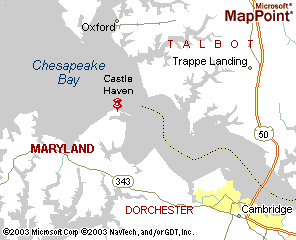
Castle Haven on the Choptank River
Find any good map of the Chesapeake Bay,
and you should quite clearly see a chunk of land jutting into the Choptank
River, just west of Cambridge, marked Castle Haven. The name dates back to 1659
and is often used to refer to the neck of land between LeCompte Creek and the
Choptank along what is now known as LeCompte Bay. The name
has also been pinned to the mansion located at the western tip of this bay at
the end of Castle Haven Road.
In 1659, Anthony LeCompte
patented 800 acres of what would later be known as Castle Haven Neck. He titled
his site "Antonine" or "Land of St. Anthony." The bay and the creek fronting
his property would carry his name posthumously. An earlier landing by Anthony
on the Western Shore of the Chesapeake, had been named "Compton". Both tracts
had been granted by Lord Baltimore. The
800 acre estate remained largely intact for over 200 years.
The 100 acres at the western tip of LeCompte Bay, was also
patented in 1659, about two weeks prior to Anthony's patent, by Dennie Choren who
referred to his land as "Castle Haven." Whether Castle Haven was ever owned by
a member of the LeCompte family is currently uncertain and doubtful. Although most
descendants identify the point and it's mansion as the ancestral LeCompte home,
records indicate that LeCompte Creek really
deserves that honor, as well as the house that burned down there in the late
1800s. The land where Anthony's first home was located, was sold out of the family in 1924 for the first time. Nevertheless, in the 21st century, there are still LeCompte descendants who own property on LeCompte bay.
(Read Full Article)January 4, 1925
newspaper clipping about sale of Castle Haven.
Castle Haven on the Choptank River should not be confused with 200
acres of property along the Wicomico River bearing the same name. This
southern Castle Haven sits in Somerset
County and was patented in 1673 by Henry Hayman and is later associated with
families of Cornelius Anderson, Jonas Passwater, Alexander Fullerton, John
Reddish and Dominick Jackson.
Although there is some question as to where the first few children
of Anthony and Hester were born, they certainly raised all their children along
the Choptank at Antonine, which became part of Dorchester County in 1669. Moses LeCompte, son of Anthony, helped establish a Ferry service
as early as 1690, to link Castle Haven with Chlora Point on the other side of
the Choptank River in Talbot County. No doubt the ferry service helped
introduce many a potential spouse to the young ladies and gentleman residing at
Castle Haven Neck. Perhaps that was worth the four thousand pounds of tobacco
that was paid to the ferryman each year.
The former Choptank River Lighthouse situated between Benoni Point and Castle Haven. Learn more of its history.
Artwork by Richard C. Moore
A visit confirms the wisdom of Anthony, as the location offers the
most expansive, unobstructed view of the Choptank River, and even the
Chesapeake Bay, of any place along the shore. Of course, the site made an
inviting target for the British who had brought a considerable fleet up the
Chesapeake Bay during the War of 1812. It couldn't have been too large a
surprise to the Reverend James Kemp (1764-1827), bishop of Maryland, who
resided at Castle Haven, when his tenant farmers reported the loss of poultry
and cattle after a raid on October 19, 1814.
In addition to Dr. Kemp, we know that Maryland Governor Thomas
King Carroll (1793-1873) and his family, including Anna Ella Carroll
(1815-1893), used the mansion at Castle Haven point as a summer house. At the end of the nineteenth century, the mansion was the home of Col. Wilbur Fiske Jackson and his wife Alice P. Smith. Today, Castle Haven mansion is a privately owned residence, a portion of
which reveals the foundation of a 1700s home.
Editor's Note: I would love to
hear from
anyone who knows all or just a portion of the ownership history of Castle Haven - especially the old
home on the point. Also curious to learn why the names Compton and Castle Haven
were chosen. Perhaps the names reflect places and events back in England.
Sources:
Old Harford Town Maritime Center. "Choptank & Tuckahoe
River Guide." [Online] 2003 previously at http://www.riverheritage.org/Riverguide/index.html
updated url: http://www.choptankriverheritage.org/RiverGuide/
Rich, B. Preston, email correspondence, 1-Jan-2014. Descendant of Wilbur Jackson.
LeCompte Bay, Maryland
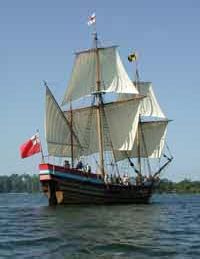
The Skipjack, "Nathan of Dorchester," sails along the waterways of Dorchester County, MD. Visit
Nathan online
LeCompte Bay on the Choptank River bears the name of the
family who first built a home on its northwest extension,
Anthony & Hester LeCompte. A small creek
feeding the bay also bears the name. The embayment occupies a southern edge of
the Choptank River in Dorchester County, Maryland between Horn Point on the
Eastern end, and Castle Haven on the Western
end.
This quiet, shallow bay, occasionally the overnight anchorage of a
cruising sailboat, mostly serves the area wildlife and the residents of its
shores. But as early as 1690, at the Castle Haven end of the Bay, a ferry
service ran across the river to Chlora Point in Talbot County. An active wharf
remained at Castle Haven into the early 1900s.
The Maryland Dove, built on the shores of
LeCompte Bay, commemorates the original Dove of 1634, part of Lord Baltimore's
expedition to Maryland.
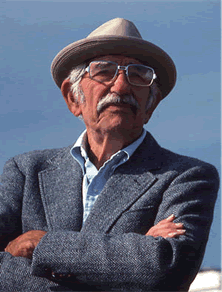
For many years, LeCompte Bay and Creek
were known for the boatyard of James B. Richardson (1906-1991), a master boat
builder descended from Anthony LeCompte on his mother's side and a long line of
shipwrights on his father's side.
Jim Richardson
In 1977, Jim and his team worked for fifteen months on the shore
of LeCompte Creek to craft a full-scale, functional reproduction of the
Maryland Dove, the ship that brought the Calverts and others to the New World
in 1634 for the founding of Maryland. The replica frequently sails the
Chesapeake and is currently harbored in St. Mary's City. (See
more facts about the Dove).
Footnote: James Byron
Richardson Ancestry: (James Byron8
> Lena W. LeCompte7 > Philip Isaiah6 >
Samuel5 > Isaiah4 > William3 >
Moses2 > Anthony1) According to the
Richardson Maritime
Museum in Cambridge, Jim Richardson stood out from other late 20th century
boat builders for his view to the past, which sought to rediscover, preserve,
and pass on methods used by craftsmen of previous generations. The museum named
in Jim's honor is a waterman's museum dedicated to the craftsmen and culture of
traditional Eastern Shore boat building.
Sources:
Old Harford Town Maritime Center. "Choptank & Tuckahoe
River Guide." [Online] 2003 previously at http://www.riverheritage.org/Riverguide/index.html
updated url: http://www.choptankriverheritage.org/RiverGuide/
The LeCompte Wildlife Management Area (WMA) was named
in honor of Edwin Lee LeCompte (1874-1947),
Game Warden for the State of Maryland (1916-1945), son of Francis Asbury &
Eveleene Foxwell LeCompte, and descendant of Anthony LeCompte.
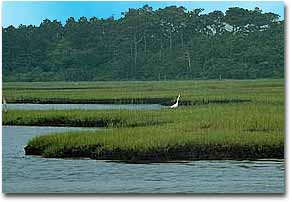
WMA Photograph by Chuck Prahl Learn more about LeCompte WMA online.
The 500 acre WMA provides a refuge for many native flora and
fauna, but was created with a mandate to preserve the Delmarva fox squirrel,
which was listed as an endangered species in 1967. Wildife biologists have
introduced numerous conservation programs at LeCompte WMA such as model
agricultural fields, the reintroduction of the wild turkey (after a 200 year
absence on the Eastern Shore), habitat management practices, and the Wetland
Restoration Project for migratory birds. The site even provides unique
opportunities for hunters with disabilities to hunt waterfowl on public
land.
Visitors are treated with a pleasant, well-documented nature hike
through LeCompte WMA. To learn more visit
LeCompte WMA online.
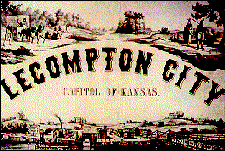
For a few short years, Lecompton, named for a Castle Haven descendant, was the territorial capital of Kansas.
The small, quiet town of Lecompton belies its roots as the
once future capital of Kansas and birthplace of the Lecompton Constitution, a
document that stymied the U.S. Congress, split the Democratic Party, elevated
Abraham Lincoln's political career, and precipitated the War Between the
States.
In 2000, Lecompton was home to a population of about 600. Stark
contrast to it's populous neighbors Lawrence (80,000) and Topeka (120,000). At
the height of its prosperity, in 1857-58, Lecompton was the quickly expanding
capital of the new Territory, with a number of large hotels, at least four
church organizations, the United States Court, the land office, and a
reputation as the "Wall Street of the West." The stage lines to Kansas City,
Leavenworth, and St. Joseph, MO were all headquartered in Lecompton, a measure
of its central importance to settlers, politicians, and land speculators.
This one square mile bluff overlooking the Kansas River, was
founded with the name "Bald Eagle" in 1854 on a 640-acre Wyandotte Indian land
claim. The town was renamed the same year to honor Judge Samuel Dexter LeCompte, chief justice of
the Kansas territorial supreme court and president of the Lecompton Town
Company. As an appointee of U.S. President Franklin Pierce, Judge LeCompte, at
age 40, had recently come to Kansas from Maryland to help prepare the Territory
for statehood.
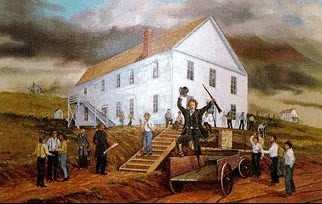
In the fall of 1857, the Lecompton Constitutional Convention met and drafted a pro-slavery constitution in the upper story of Constitution Hall.
After the Kansas-Nebraska Act of 1854, Lecompton quickly became a
political hot spot for territorial, national and even international politics,
as a decision had to be made by the settlers of the Territory whether Kansas
would be a free state or a slave state. Abolitionists flocked to the nearby
town of Lawrence, pro-slavery advocates to Lecompton. Charles Robinson, a
leader of the free-staters, who would later become the first governor of
Kansas, was imprisoned in Lecompton and actually tried for treason by the
pro-slavery judiciary. As voters, who immigrated daily, prepared to decide the
fate of the State, partisan politics, fraught with fraud, intimidation,
violence and even murder, earned the region the title "Bleeding
Kansas."
The territorial legislature met in Constitution Hall in the Fall
of 1857 and drafted the Lecompton Constitution with the intent of making Kansas
a slave state. While Democratic President James Buchanan accepted the document,
presidential contenders Lincoln and Douglas publicly debated the consequences,
and the U.S. Senate postponed a decision. In 1859 the "Free Staters" gained a
majority stake in the territorial legislature, repealed the pro-slavery,
pro-plantation laws and adopted a free state constitution.
The events of Lecompton and the Kansas Territory furthered the
distance in relations between the North and the South. After seven southern
states seceded from the Union between December 20, 1860 and January 26, 1861,
the logjam in Congress was cleared, and Kansas became a free state on January
29, 1861. The Kansas legislature chose Topeka as the capital, and Lecompton
immediately ceased growing. Property values plummeted from highs of $1,000 to
less than $25, and the population swiftly declined, never to exceed 1,000
again. Ten weeks later, the War Between the States began.
Constitution Hall still stands, and visitors can explore the
Territorial Capitol/Lane Museum dedicated to Lecompton's early days on the
political frontier.
Lawrence Convention and Visitors Bureau. "Lawrence Day
Tripping." [Online] 2003 previously at http://www.visitlawrence.com/visitor/daytripping.php
Cutler, William G. "History of the State of Kansas." Douglas
County, Part 31. [Online] 2003 previously at
http://www.kancoll.org/books/cutler/douglas/douglas-co-p31.html
Blackmar, Frank W. "Kansas: A Cylcopedia of State History."
Volume II, pp.40-42. (Chicago: 1912). Transcribed July 2002 by Carolyn Ward.
[Online] 2003 previously at http://skyways.lib.ks.us/genweb/archives/1912/j/judiciary_territorial.html
Lecompte, Louisiana
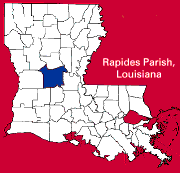
Historians agree that the town of Lecompte was named after
the world-class race horse, Lecomte, who was
arguably the fastest colt in the world in 1854. Lecomte was given his name as a
compliment by local breeder Jefferson Wells, who received the thoroughbred as a
gift from his friend and planter, Ambrose Lecomte. We learn a little about
Ambrose and Jefferson from the Ouachita Telegraph of 1883:
Lecompte, LA, named after a race horse, is located in Rapides Parish in the heart of Louisiana.
"Ambrose Lecompte, one of the oldest citizens of Natchitoches
parish, died a few days ago. Commenting on his death, the Shreveport Times
Says: Mr. Lecompte before the war had quite a penchant for fine horses, and
more from taste than profit, bred and ran race horses. Like the late Col. Jeff
Wells, he ran his horses for the purses, but seldom, if ever, bet on them. The
colt Lecompte, owned by Wells, and who ran the famous race over the Metarie
course against Lexington, was named in compliment to the gentleman turfman.
Although Mr. Lecompte lost largely by the war, he was fortunately out of debt
and retained a competency."
There is, however, some disagreement over the spelling of Lecomte.
Although references like that above refer to Ambrose as a "Lecompte," the more
colorful, and perhaps correct, story relates how the railroad company
incorrectly inserted a "p" into a sign on the side of a train depot, and that
the town was known as Lecompte ever after. Interestingly enough, one of the
first American railroads ran from Alexandria, LA to Lecompte.
We do know that regardless of the spelling, Ambrose Lecomte was
not a descendant of the Castle Haven LeComptes of Maryland. Ambrose Lecomte and
his father, also named Ambrose, ran Magnolia Plantation, one of the largest
cotton producers in Natchitoches Parish, LA from 1830 to early in the
20th century, producing well over 1,000 bales of cotton annually.
Ambrose Sr., or perhaps his father, was a French immigrant, but any connection
to Anthony LeCompte is presumed to be quite distant.
If you decide to visit LeCompte, LA, your tastebuds may be pleased
to learn that LeCompte has been designated the Pie Capital of Louisiana. Be
sure to check out the annual
LeCompte Pie
Festival, which takes place on the grounds of the old LeCompte
High School.
O'Connor, Richard. "Cotton Gins and Presses, Reading
Industrial Artifacts at the Magnolia Plantation." [Online] 2003 previously at http://crm.cr.nps.gov/archive/20-14/20-14-5.pdf
"Obit of Ambrose Lecompte." The Ouachita Telegraph.
17-Mar-1883. p2 col2. Transcribed by Ms. Lora Peppers at the Ouachita Parish
Library for USGenWeb. [Online] 2003 previously at http://ftp.rootsweb.com/pub/usgenweb/la/ouachita/obits/ot1883.txt
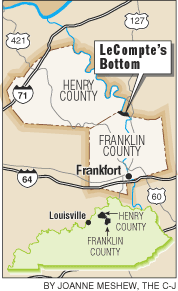
LeCompte's Bottom, a bend on the Kentucky
River, is the nexus between Henry, Franklin, and Owen counties.
The adventures of Pioneer Charles LeCompte and Surveyor
William McConnell, who left the Ohio River and traveled up the Kentucky River
toward the Elkhorn region as early as 1775, are memorialized in the names of a
few places along the way.
One such place is LeCompte's Bottom, a significant bend in the
Kentucky River in Henry County, KY. Many of Charles's descendants, particularly
those of his son Joseph, who became a
Congressman in 1825, settled in the area. Of course, the area was considered
Virginia until the State of Kentucky was formed in 1792.
LeCompte's Bottom has been the subject of debate coming into the
21st century as it geographically fits into Franklin County, but has
historically always been attached to Henry County. The Courier-Journal of
Louisville, KY reported:
"... it is a 'politically ill-assigned piece of geography,' as a
former resident once described it. The Kentucky River, two creeks and some
rough terrain hem it in. Getting anywhere else in Henry County requires
crossing into Franklin County, then out again."
Further upstream from and south of LeCompte's Bottom, is North
Elkhorn Creek, which in turn is fed by LeCompte Run and McConnell Run in Scott
County, KY. These two streams, named for the early explorers, surround the area
known as "Big Spring" and "Stamping Ground," named for the herds of Bison who
were seen stamping down the undergrowth in the 18th and early 19th
centuries.
Sources:
Lindsey, Kenneth G. "Anthony Lindsay, Jr." 1997. [Online]
2003 previously at http://www.geocities.com/~kenlindsay/anthony2.htm
Wolfe, Charles (AP). "Some in Henry County seek secession:
LeCompte's Bottom could become part of Franklin County." Courier-Journal,
Louisville, KY. 27-Jan-2002. [Online] 2003 previously at http://www.courier-journal.com/localnews/2002/01/27/ke012702s145120.htm
Franks, Beulah A. "Annie Wiley and her Obituary Scrapbook."
[Online] 2003 previously at http://www.rootsweb.com/~usgenweb/ky/woodford/obits/wiley/aw01.html